
DENTAL CROWNS
Protect A Tooth
That Needs More Support.
When structural breakdown or deep decay leaves compromised tooth structure vulnerable, a custom crown provides 360-degree reinforcement. We prioritize conservative preservation, recommending full coverage only when clinical evidence confirms it is the most durable solution.
Comprehensive diagnostic evaluation · Natural aesthetics · Northwest Portland clinic
UNDERSTANDING DENTAL CROWNS
When A Filling
May Not Be Enough.
Fillings restore minor cavities by bonding directly within the tooth walls. However, when structural loss compromises more than half of the tooth's natural perimeter, chewing forces can fracture the remaining enamel.
A Crown Should Protect A Tooth For A Clear Clinical Reason.
01 — STRUCTURAL LOSS
Large Area of Decay
When deep decay undermines a major portion of natural cusp anatomy, removing the decayed tissue leaves insufficient sound enamel for a standard composite filling to reliably anchor.
02 — TOOTH INTEGRITY
Fracture or Structural Crack
Cracked tooth syndrome creates microscopic flexure during chewing, triggering sharp sensitivity. A full-coverage crown acts as a protective splint, binding the tooth segments together to prevent vertical root fracture.
03 — RESTORATION BREAKDOWN
Large or Failing Filling
Aging silver amalgam or oversized composite restorations often develop recurrent micro-leakage around their margins. Replacing an extensive filling with a crown restores structural integrity before catastrophic failure occurs.
04 — ENDODONTIC PROTECTION
After Root Canal Treatment
Endodontic treatment removes the internal pulp blood supply, leaving the remaining tooth brittle and hollowed out. A custom crown fully seals the access canal and shields the tooth from heavy masticatory stress.
05 — OCCLUSAL WEAR
Significant Wear or Damage
Severe bruxism (clenching or grinding) or chemical acid erosion can wear enamel down to exposed, sensitive dentin. Restorative crowns rebuild proper vertical bite height and restore chewing efficiency.
THE NWPD APPROACH
Protect What Remains.
Restore What Was Lost.
Our restorative philosophy is uncompromisingly conservative. We never recommend full coverage when healthy enamel can be safeguarded. Before designing a restoration, our clinical team thoroughly evaluates your complete masticatory system - assessing underlying bone architecture, occlusion stress dynamics, periodontal foundation, and remaining biologic width.
Crown, Filling, Root Canal, Or Something Else?Every clinical recommendation begins with precise diagnostic imagery and force-distribution analysis. We present every viable biological pathway so you understand precisely why a crown is or is not indicated for your tooth.
01. SUPPORT
Reinforce compromised cusps and protect vital root structure against micro-fractures under heavy masticatory load.
02. RESTORE
Rebuild original tooth height, anatomic contours, and precise chewing efficiency for balanced jaw kinematics.
03. PROTECT
Hermetically seal prepared margins to prevent recurrent decay and preserve endodontic health for decades.
04. BLEND
Custom shade-matching and multi-layer ceramic translucency harmonize seamlessly with adjacent natural dentition.
WHAT TO EXPECT
A Clear Process
From Evaluation To Final Fit.
Restoring a damaged tooth is a precise, collaborative treatment. Every stage is engineered to prioritize your immediate comfort, preserve healthy tooth structure, and deliver an exact, natural-feeling bite.
STEP 01 — CLINICAL ASSESSMENT
01. Thorough Evaluation & Diagnosis
We examine the tooth, surrounding gums, and root stability with high-definition digital radiography to confirm that a crown is the ideal, most conservative restorative choice.
STEP 02 — TOOTH PREPARATION
02. Gentle Shaping & Structure Prep
Under gentle local anesthesia, the tooth is meticulously shaped to remove compromised decay while preserving as much natural, healthy enamel and dentin as possible.
STEP 03 — DIGITAL OPTICAL SCAN
03. 3D Digital Scan & Shade Matching
No messy trays or goopy impression paste. Our handheld intraoral scanner captures a micron-precise 3D map of your tooth alongside custom shade mapping to harmonize with your smile.
STEP 04 — INTERIM PROTECTION
04. Custom Temporary Placement
A tailored temporary crown is fitted immediately to shield the prepared tooth from thermal sensitivity, maintain proper spacing, and let you chew normally while your permanent ceramic is crafted.
STEP 05 — PERMANENT RESTORATION
05. Bonding & Occlusal Calibration
Once your custom ceramic crown arrives, we verify fit, contacts, and shade before permanently bonding it with clinical-grade resin cement and fine-tuning your natural bite alignment.
AFTER YOUR CROWN
Protecting
Your Restoration.
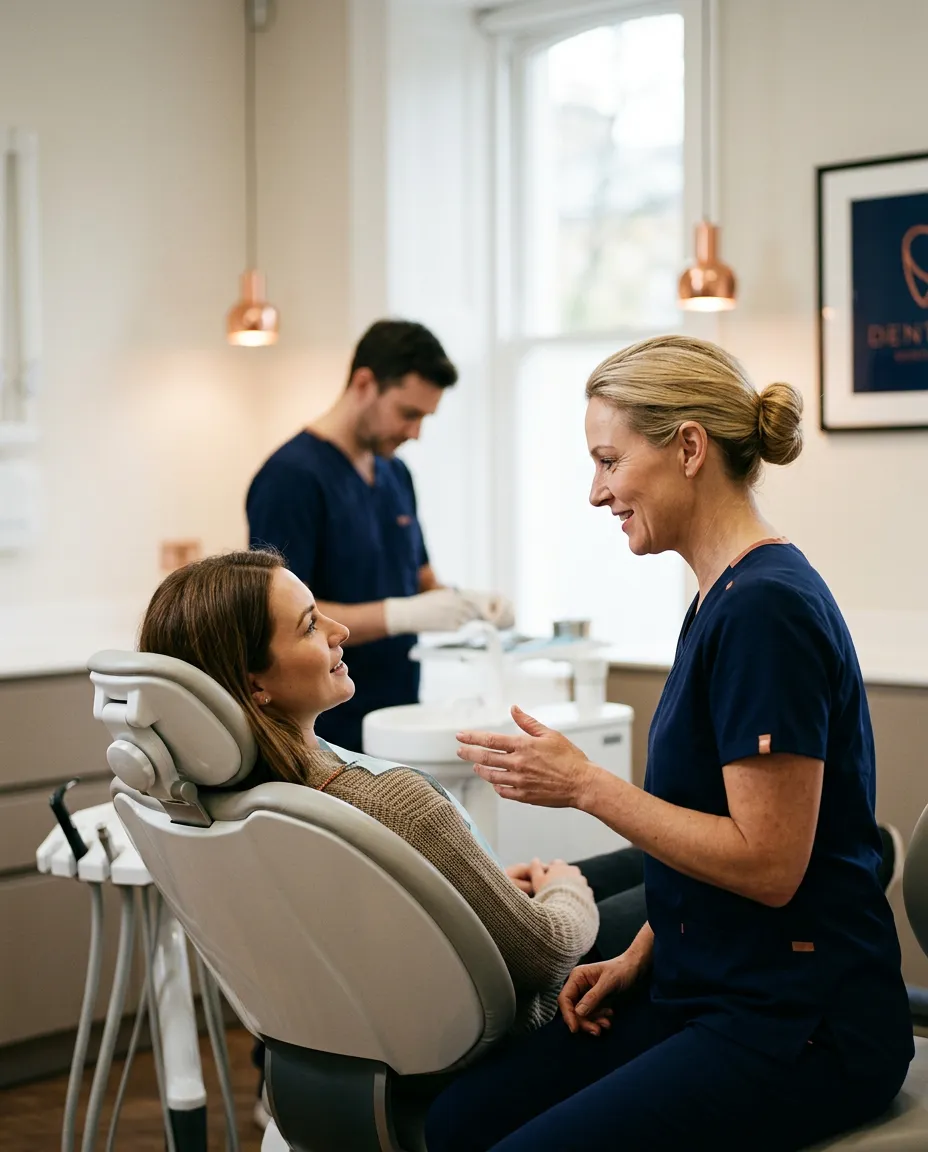
A custom porcelain crown protects compromised tooth structure, but its long-term stability relies on consistent daily oral stewardship and professional monitoring.
Brush twice daily with non-abrasive fluoride toothpaste and floss carefully along the restoration margin to remove subgingival plaque.
Healthy periodontal tissue stabilizes the restoration boundary and prevents marginal recession that exposes underlying tooth structure.
Inform our clinical team if you experience uneven contact or bruxism forces so minor occlusal adjustments or nightguards can prevent ceramic stress.
Regular preventative visits allow digital radiographs and physical margin evaluations to verify restoration integrity over time.
Restoration durability depends upon oral hygiene, occlusal forces, salivary chemistry, and overall periodontal health rather than a predetermined timeframe.
RESTORE + PROTECT
Does Your Tooth
Need More Support?
Whether addressing subtle structural fatigue or protecting a treated tooth, an accurate clinical evaluation comes first. We diagnose conservatively and design long-term restorations tailored precisely to your bite.
Comprehensive diagnostic consultation • Transparent restorative recommendations • Northwest Portland location
Redefining the dental patient experience with architectural minimalism and Pacific Northwest warmth.
Office Hours
Monday: 7:00 AM - 4:00 PM
Tuesday: 7:00 AM - 4:00 PM
Wednesday: 7:00 AM - 4:00 PM
Thursday: 7:00 AM - 4:00 PM
Friday: Closed
Saturday: Closed
Sunday: Closed
Location Details
Phone: (503) 228-6294
Address: 2311 NW Northrup St. Suite 101 Portland, OR 97210
Email: [email protected]
Contact Information


© 2026 Northwest Portland Dental. All rights reserved. | Privacy Policy | Accessibility